


news 2025
« BACK
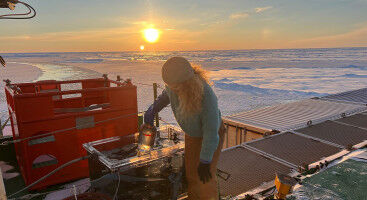 Important phenomenon discovered in the Arctic - could boost marine life
 Sled Dog DNA Reveals Hidden Chapter in Greenland’s History
 Old aerial photos give scientists a new tool to predict sea level rise
Earth Sciences
Results 1 - 6 of 6.
Environment - Earth Sciences - 20.10.2025
Researchers from the University of Copenhagen have discovered an important phenomenon beneath the Arctic sea ice that was previously thought impossible. This phenomenon could have implications for the food chain and the carbon budget in the cold north. The shrinking sea ice in the Arctic Ocean is, overall, a disaster.
Life Sciences - Earth Sciences - 21.08.2025
Greenland The Inuit arrived in Greenland several hundred years earlier than previously believed. This is revealed by a genetic mapping of sled dogs, conducted by researchers from institutions including the University of Copenhagen. For many of us, dogs are our best friends, but in Greenland, sled dogs have for centuries been more than just loyal companions: they are an indispensable workforce, contributing to hunting and pulling sleds across the country's icy terrain.
Environment - Earth Sciences - 10.08.2025
Heatwaves at Sea May Force the Ocean to Release More CO2
We already know that marine heatwaves can harm the ocean's animals and reefs. Now, a new study reveals that marine heatwaves may also weaken the oceans' ability to store carbon Heatwaves not only occur on land - they also occur in the oceans, causing ocean temperatures to stay warmer than normal for longer periods.
Environment - Earth Sciences - 03.07.2025
Sea Levels Researchers from the University of Copenhagen have gained unique insight into the mechanisms behind the collapse of Antarctic ice shelves, which are crucial for sea level rise in the Northern Hemisphere. The discovery of old aerial photos has provided an unparalleled dataset that can improve predictions of sea level rise and how we should prioritise coastal protection and other forms of climate adaptation.
Earth Sciences - Environment - 21.03.2025
Core samples from Greenland's seabed provide first historical overview of plastic pollution
Plastic Pollution By coring the seabed at 850 m water depth in Disko Bay off Greenland's west coast, researchers from the University of Copenhagen have obtained the first historical record of plastic pollution in Greenland. The new data suggest a link to local socio-economic development and represent a step towards developing a common method for analyzing and mapping global microplastic pollution.
Environment - Earth Sciences - 04.03.2025
Resilient algae may speed up Greenland ice melt
New research reveals that ice algae can store nutrients which may enable them to colonize more of the ice sheet, darkening and melting it. It's May. The sun is up and the heat from that distant star can finally be felt as a warm tingling sensation on the skin. The snow starts to melt. Flowers and plants break through the ice gasping for light.


