Space technology
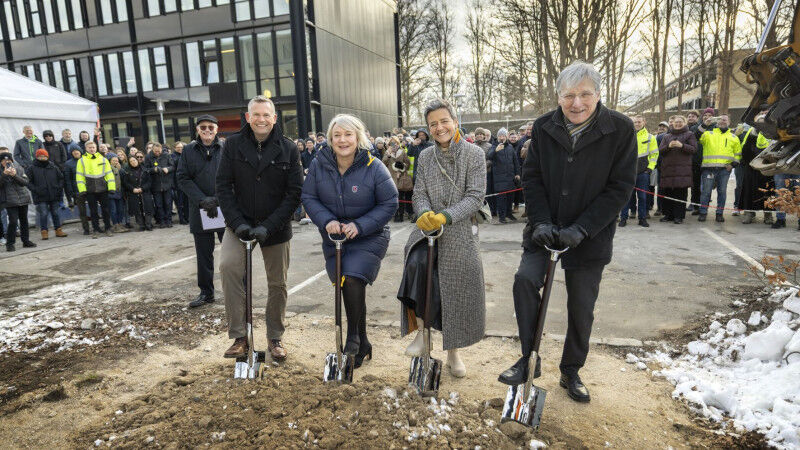
As part of a significant DTU investment in the space and defence area of around DKK 2 billion over a five-year period, the first sod was turned for a major expansion of activities at DTU Space, Denmark’s largest space research institute.
DTU is strengthening Danish research in space, defence, and climate with a new research building and increased investments of around DKK 2 billion.The investments are driven by growing demand for space technology, consulting, and satellite data-particularly in climate, security, and Arctic monitoring, where Denmark has a significant responsibility and strategic role. The investments are thus also being made in a broader national context, where the government has allocated more than 19 billion Danish kroner to research and innovation over the next four years.
"Space is hugely important for Europe’s future, and our commitment in this area must reflect that. We must not sit on the sidelines and follow developments in space; we must help shape them. When DTU Space expands and invests heavily, it strengthens Europe’s ability to stand on its own two feet in the space sector. This is greatly needed in the fierce global competition to develop technology and translate research into concrete solutions," says Minister for Higher Education and Science Christina Egelund.
DTU is prioritising the space and defence area, allocating approximately DKK 2 billion over a five-year period, distributed as around DKK 300 million annually and around DKK 500 million for new research infrastructure, including the new building.
"With the new research building and the total investments, DTU is strengthening its research capacity in the space sector, where advanced infrastructure is crucial for society, security, and international cooperation. DTU and Denmark are already strong in the development and application of space technology, but these additional long-term investments are important to strengthen this important area in these times," says DTU President Anders Bjarklev.
Growing international engagement
The research facilities are being expanded to accommodate DTU Space’s growing national and international activities in space research, space technology, and satellite-based knowledge. The new research facility will bring together advanced laboratories and testing facilities for the institute’s researchers and engineers.
"The expansion is taking place as DTU Space’s project portfolio and international engagement grow, thereby increasing our need for modern and advanced research infrastructure," says Henning Skriver, Director of DTU Space.
DTU Space currently participates in a wide range of international space missions in close collaboration with ESA and NASA. The missions span areas such as Earth observation and climate, solar system and universe exploration, space-based security, and Arctic monitoring, and typically have time horizons of 5-10 years or more. This places high demands on stable research environments, advanced testing facilities, and long-term investments.
New research building B330
- Building 330 will provide the framework for research, development, and testing of space instruments and technology in line with growing activities and strengthened international cooperation with, among others, ESA and NASA.
- The building is expected to be completed in 2028 and will consist of approximately 8,200 square metres spread over five floors and a basement. The building will be approximately 27 metres high. Outdoor observation facilities can be established on the roof.
- The building will house advanced research and testing laboratories, including clean rooms with temperature, humidity, vibration, and contamination control. It is designed for a continuous research and testing process, where instruments can move safely between development and testing environments via airlocks.
- The facilities are supported by specialized infrastructure, such as liquid nitrogen for cooling and stress testing, and include a robotics lab, offices, teaching facilities, common areas, and facilities for communicating space research and space technology.
- Building 330 is being constructed in collaboration with general contractor Elindco, consulting engineers Artelia, and architects Christensen & Co Arkitekter.
Address
Anker Engelunds Vej 101 2800 Kongens Lyngby CVR-nr. 30 06 09 46