Teaching
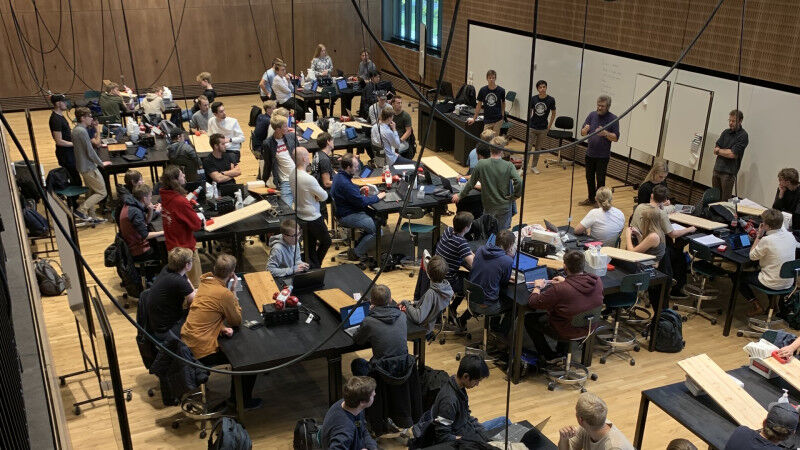
Lectures and step-by-step tutorials are out the door in the experimental learning spaces in building 306 at DTU Lyngby Campus. Instead, students collaborate to organize open-ended physics experiments, enhancing their learning.
At DTU, students learn physics in different ways. In the experimental learning spaces at DTU Lyngby Campus, creativity and collaboration are at the centre of learning.
The experiment is a focal point of engineering. It forms the basis for technical and scientific research, for the work that engineers do in industry, and it is the very foundation of innovation. That’s why it’s central at DTU and a focal point when we work to develop teaching methods and new approaches to learning.
The course ’Physics’ is a so-called polytechnical foundation course, which means that all’undergraduate students in the BSc in Engineering programme take it as part of their basic education. Around 1000 students pass through the experimental learning rooms in Building 306 at Lyngby Campus every year. The rooms are specially designed to teach the basic rules of physics differently from seat-to-seat teaching.
The laws of physics learned through creative collaboration
Carsten Knudsen, Senior Executive Education Officer at DTU Physics, has helped develop the experimental learning spaces and teaches the Physics course. He developed the course to challenge young students to not only learn physics differently, but to practice independent thinking, collaboration and critical reflection:
"We try to create a space to empower students’ creativity and ingenuity by giving them a problem to solve without a ’recipe’. The students work in self-selected groups of three and are encouraged to collaborate - they have to talk to each other, to draw, calculate and experiment by building from materials at hand. And that means they have to approach the material completely differently. It’s challenging for most students - especially at first," he says and continues:
"It takes a little time to realize that you do learn physics on this course, but you learn it by being methodical and critical and working together to find a solution to a problem. And that’s an important competency as a student and an engineer."
You learn the most outside the auditorium
Research shows that most students love lectures because they get a ’real’ feeling of learning, but it also shows that they learn less than they think from sitting passively and receiving instruction. Being able to memorise things and hit the correct answer does not necessarily mean that you have understood a physical or mathematical concept in depth and can apply it in other contexts.
"We know that students’ learning outcomes are higher when they work with experiments. It’s the person doing the work who learns something," explains Associate Professor of Engineering Didactics Pernille Rattleff from DTU Learning Lab before elaborating:
"And you do this because you work actively with the material, testing theses and assumptions, failing and trying again. It increases students’ understanding of complex topics, and even if they don’t hit the right solution right away, they have understood the underlying concepts and contexts of a problem - they don’t just learn to apply formulas or follow recipes. They also gain a deeper, conceptual understanding that they can apply in new, complex contexts."
Conceptual understanding as a research area
Conceptual understanding is precisely what Kasper Zøllner, a PhD candidate employed at DTU Learning Lab and DTU Energy, is working on in his PhD project. He is investigating how best to support student learning and is using the teaching in the Physics course as a field of study.
"Being active and setting up an experiment yourself in the lab that, for example, puts Newton’s laws of motion into play, supports your conceptual learning because you are ’forced’ to understand the concepts before you can set up an experiment that gives you a solution," he says before adding:
"In this course, no ’cookbook’ guides you step by step to the right result. It’s a way to learn the critical and independent thinking that will eventually make you a good engineer."
"That’s also why you don’t hand in reports on the course," Carsten Knudsen adds. "Here, you hand in short, preferably handwritten journals that briefly describe the problem and the methodological considerations. And that’s because that’s the way engineers work in industry. We use our knowledge and competencies to solve a task in the best possible way. That’s the approach we strive to teach all the talented students who come through our course every year."
A good mix of active and passive learning
That’s not to say that traditional auditorium teaching is doomed. Plenty of knowledge and theory can’t be learnt in any other way than by sticking your nose in a book and then sitting down in an auditorium, having the text interpreted by competent teachers and asking probing questions.
"But we want the mix of active and passive learning. Here we are working to educate the engineers of the future, who have both a grasp of theory and methodology, while at the same time being able to develop concrete and practical technology and solutions that benefit our society," says Pernille Rattleff.
DTU Summer School for Teaching Excellence
DTU wants to have the best engineering education in Europe. Therefore, we must ensure the best possible teaching diversity and our teaching methods must engage students and convey the material in ways that support learning.
DTU’s Summer School for Teaching Excellence is offered every spring. This year, the Summer School focused on how DTU educators can support and strengthen engineering students’ conceptual understanding.
DTU Learning Lab organizes the Summer School and is a professional development opportunity for DTU educators to strengthen their teaching skills and insight into learning methods.
Read more about the Summer School for Teaching Excellence.
Address
Anker Engelunds Vej 101 2800 Kongens Lyngby CVR-nr. 30 06 09 46