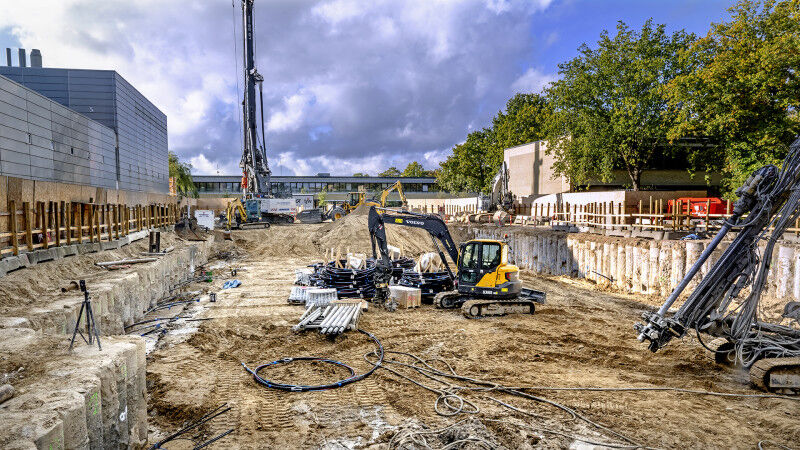
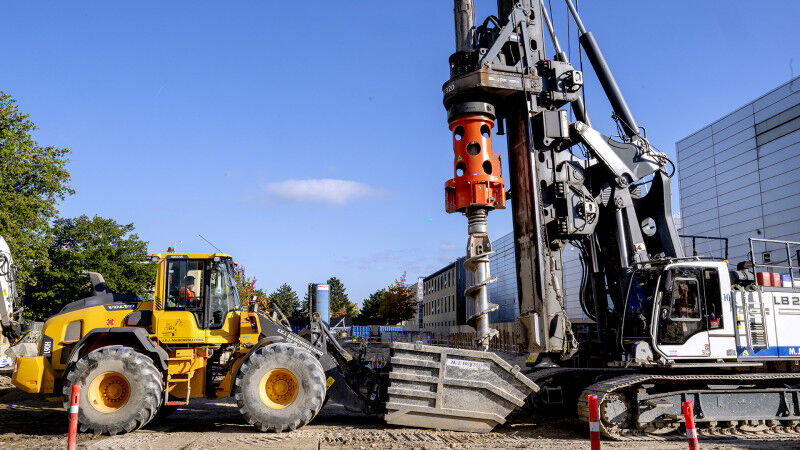
The sound of the 90-tonne drilling machine working away at DTU’s Ørsteds Plads is unmistakable. Work is now underway to drill deep underground to build Nanolab Phase 4: a new state-of-the-art facility providing access to advanced equipment and environments for developing and fabricating quantum chips.
The new building will expand and improve DTU Nanolab’s existing facilities and will include a 700 m2 cleanroom to be equipped with the latest generation of nanofabrication tools and instruments.
Here, researchers and businesses will be able to develop and produce physical components for quantum sensors, quantum encryption devices, or quantum computers requiring extremely precise and controlled nanofabrication environments. It will help strengthen Denmark’s position as a leading nation in quantum technology and innovation.
The technology is important because it can break the boundaries of what we thought was technologically possible. This can accelerate research into new materials, medicine, and chemical processes, among other things.
"Top-class facilities are needed to produce quantum chips in Denmark. That’s why our focus in Nanolab Phase 4 is clearly on fabrication. The new building will not only serve as a boost for research and development, but also for small-batch production and scaling-up towards industrial manufacturing. We will cover the whole spectrum-from basic research and prototyping in nanotechnology and quantum technology to developing industrial production processes. The goal is to keep both startups and the emerging industry in Denmark," says Jörg Hübner, Director of DTU Nanolab.
Among the world’s leading cleanrooms
Nanolab Phase 4 started out as an idea in 2019 and has since evolved into a key part of Denmark’s strategic investment in quantum technology. The building will meet the growing demand from researchers and businesses working with nanotechnology, quantum chips, and advanced sensors.The backdrop is a growing need for more advanced and flexible cleanroom facilities as technologies become increasingly complex and require extremely controlled environments. The cleanroom will be one of the world’s leading open-access facilities of its kind.
This means that businesses can also install their own equipment and move from research to small-scale production. In addition, they will gain access to specialized machinery and technologies which would be expensive and complex for them to install themselves, and, in addition, they will be close to DTU’s research environments and become part of a larger ecosystem in Greater Copenhagen.
The Danish Government’s national strategy for quantum technology has designated the Copenhagen region as central to Denmark’s investment in quantum technology. The area is characterised by strong collaboration between several universities, startups, established businesses and investors working to bring quantum technology from lab to market.
In addition to DTU’s strong research environments, the community includes the Niels Bohr Institute, Sparrow Quantum, Microsoft, UCPH Ventures, as well as a large number of startups and the research and production facility Quantum Foundry, which also manufactures specialized quantum chips and uses DTU’s facilities for connecting and packaging.
In recent years, DTU has seen a remarkable development in the innovation and production of quantum chips, and the University has become a sought-after partner both internationally and in Denmark. Today, DTU is home to some of Europe’s leading research environments in quantum physics and quantum technology.
The University actively participates in international collaborations and EU projects and contributes to developing both quantum hardware and software for future quantum systems. At the same time, DTU educates specialists to ensure Europe’s technological leadership position.
Visionary decision to invest in expansion
"DTU’s decision to invest in the expansion of Nanolab demonstrates a very visionary mindset. The type of technology that can be used and developed at DTU Nanolab is essential for Danish researchers and businesses to perform nanofabrication at the highest level. It will enable Danish players to develop and produce technology of the same quality as the large international nanofactories-but in a research-based R&D environment and with full Danish control and ownership," says Lene Oddershede, Chief Scientific Officer, Planetary Science & Technology, Novo Nordisk Foundation.For Denmark to play an active role in the global development of quantum technology, it is not enough to have strong research environments, says Jörg Hübner. It also requires a strategic effort that goes beyond the labs. He expects Nanolab Phase 4 to not only strengthen Danish industry and competitiveness, but also contribute positively to the European microchip ecosystem:
"If Denmark is to succeed with quantum technology, it requires more than research-it also requires production. There’s broad consensus among politicians, universities, and industry that we must avoid repeating the mistake of the electronics industry, where value creation moved abroad. Chip production brings jobs, factories, and supply chains closer together-and that’s crucial for both innovation and the economy."
Keyword is flexibility
To design the new facilities, DTU has chosen Dutch consulting firm Deerns, internationally recognized for their expertise in cleanroom technology. Among the most important requirements for a modern cleanroom is the ability to maintain extremely precise conditions for temperature, humidity, and particle levels.Even small vibrations or air currents can disrupt nanoscale measurements and production. Therefore, the building is designed with vibration dampening, electromagnetic shielding, and controlled air handling. Flexibility is key here, says Anders M. Jørgensen, Deputy Director, DTU Nanolab:
"We’re about to construct a new laboratory building that will be relevant for at least 30 years. We know that quantum technology will be a key part of operations in the next 5-10 years, but future needs are still unknown. Therefore, the construction of Nanolab Phase 4 calls for a different approach and for architects and designers thinking beyond standard specifications and equipment lists. It’s not an approach you see in many places. Often, you construct a new building and move existing activities into the new building, but in this case we wanted to create a flexible design where researchers and businesses can quickly install and replace equipment depending on research and development projects."
An extreme global race
Today, there is an extreme global race to be among the first to develop usable quantum technologies. The quantum community even talks about quantum technology making it possible for us to perform calculations we cannot even imagine, measure extremely small signals, and communicate and encrypt on a completely different scale to what was possible earlier. Lene Oddershede agrees with this:"The quantum chip is the heart of a quantum computer, and the scope of application is huge. In chemistry and life science, for example, it can help develop new forms of medicine-and in materials research, it can provide new materials that enable the green transition. In general, quantum computing can improve our understanding of systems that are inherently quantum systems, many of which are actually part of our everyday lives. In addition, specialized chips based on quantum technology are expected to drive major changes in encryption, finance, and logistics."
If you ask Jörg Hübner, he believes that quantum technology may be on the verge of a breakthrough along the lines of optical telecommunications and fibre networks, which in the late 1990s and early 2000s paved the way for infinite broadband and streaming. However, quantum technology has been a long time in development and has been refined in laboratories, but it has yet to make its way into practical applications.
"To take the next step, quantum technology must be brought down to the chip level. This requires us to make physical chips that not only demonstrate what’s possible in the lab, but which also work in the real world. It’s a giant technological leap-and one that the whole world is striving for: getting quantum technology integrated into chips. This is precisely where Nanolab Phase 4 can create opportunities for Denmark to position itself among the leaders in quantum technology," says Jörg Hübner.
Nanolab Phase 4
Cleanrooms on columns
The cleanroom in Nanolab Phase 4 will be built on columns placed on a special foundation called a waffle deck. This means that the cleanroom itself is physically separated from the rest of the building and the surrounding ground. The construction protects the sensitive equipment from vibrations from, for example, the future light rail, trucks, and technical installations. For additional protection, a wall has been built around the basement with hundreds of piles and anchors acting as a shield against vibrations. This enables the building to meet an extremely strict vibration standard.Controlled air handling
DTU has been inspired by pharmacological cleanrooms when it comes to controlling air treatment in Nanolab Phase 4. Instead of using traditional air treatment systems, a so-called desiccant technology will be used, which consists of a large rotating wheel that draws moisture out of the air. The method will utilize DTU’s district heating and ensure energy-efficient operation all’year round. According to DTU’s calculations, it is possible to achieve energy savings of up to 25 per cent with the new dehumidification system.Address Anker Engelunds Vej 101 2800 Kongens Lyngby CVR-nr. 30 06 09 46