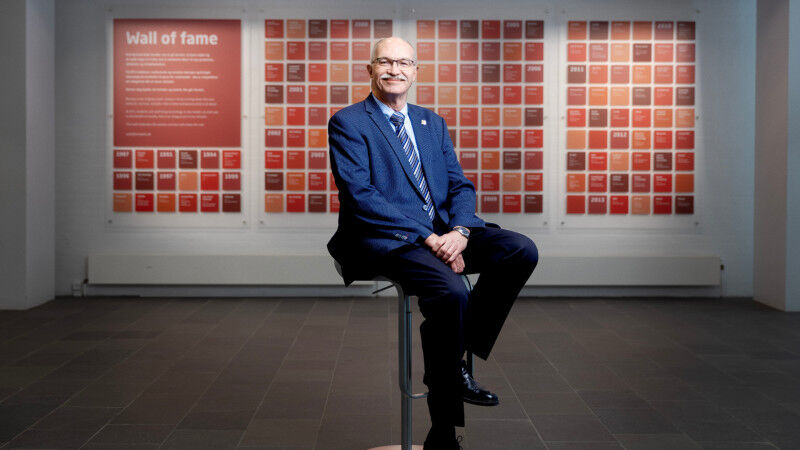
120 DTU-based start-ups in 2024. An increase in external funding from DKK 700 million to DKK 2.6 billion in just five years. And one of the top three companies filing the largest number of patent applications in Denmark-surpassed only by Vestas and Novozymes.
These are just a few of the results DTU has achieved in the field of innovation with Anders Bjarklev at the helm. Results that have been achieved after setting ambitious goals. It has contributed to DTU being named the best "university of technology" in the EU by the EngiRank ranking for the second consecutive year.
"It’s extremely satisfying to see DTU at the top of the international rankings-in terms of innovation, research, and education. It’s like seeing the return on all the good work that everyone here has been putting in over the years," says Anders Bjarklev.
Today, he celebrates his 40th anniversary as a state employee. First as a young research talent in the field of optical fibres - light conductors that can transmit information via light. Then as head of department of the former DTU Fotonik institute, which is now DTU Electro. And for the past 15 years as Provost and President of DTU.
But while innovation is now an essential part of DTU’s DNA, and a discipline that both students and researchers strive to master, back in the 1990s, resistance to entrepreneurial research was almost as prevalent. Back when Anders Bjarklev had a good idea.
’A waste of time’
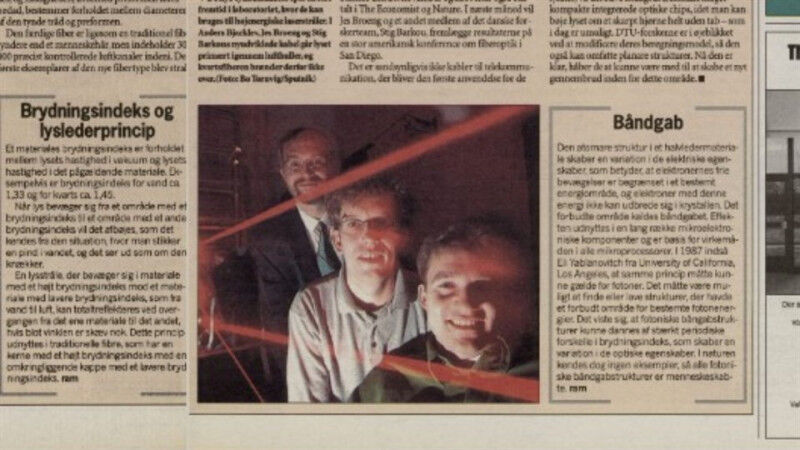
According to Anders Bjarklev, those were some ’roaring years’ - the 90s - where communication as a field of research was undergoing rapid change, and the number of people participating at conferences was booming.In his research, he had encountered the phenomenon of photonic crystals, which are known in nature as repeating structures that can control the movement of light. The phenomenon can be seen in the peacock butterfly, where the structures on the butterfly’s eyespots give a metallic sheen. The young researcher asked himself:
"Can you pack the same structures into an optical fibre? That could be really exciting!"
Exciting because it would mean that the optical fibre, which is a light conductor, could optimise the transfer of information via light - something the telecom and IT industry was accelerating in at the time. And amazing because an optical fibre is as thin as a strand of hair, and the confined space inside argues against it being possible at all. Therefore, it was necessary to design a completely new type of optical fibre.

"Innovation was not something that you should spend your working hours on," recalls Anders Bjarklev. "It was deemed a waste of time."
Only one PhD candidate-Jes Broeng-showed an interest. And when his calculations repeatedly contradicted all the textbook rules, Anders Bjarklev began to feel nervous. He saw two possible outcomes:
"Either our calculations were incorrect, and my colleagues would be proven right. Or perhaps we had struck gold."
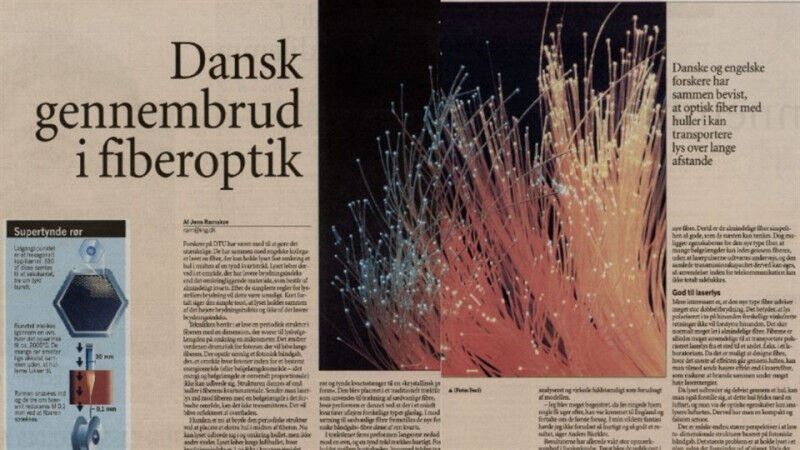
They found a group working in the same field at a university in the English city of Bath. Jes Broeng went to test their calculations in practice, and when he called Anders Bjarklev at home, it was with news that the media Ingeniøren later called ’unthinkable’:
"It works! It works amazingly well!" he exclaimed on the phone. And then things took off.
Civil engineer John Heebøll, who had just been recruited by DTU to boost innovation at a new centre, saw the potential in the two entrepreneurs, and invested half of the modest DKK 100,000 he had been allocated.
"That was a lot of money back then," says John Heebøll.
"There was virtually no capital available for innovation, so I took a big gamble because I believed in them."
The money was used to write an international patent application, and DTU and the company NKT joined as founders. In 1999, this resulted in the formation of the high-tech company Crystal Fibre A/S.
The butterfly effect
Crystal Fibre became the first research-based company to have researchers, DTU and a company involved. But it was far from the last. Considering the technology behind Crystal Fibre, the career steps Anders Bjarklev later took can be described as a butterfly effect.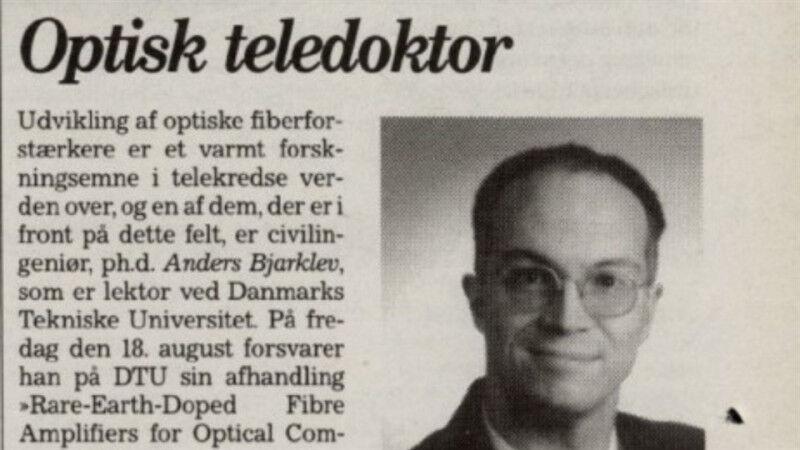
When the position as Provost at DTU was advertised in 2010, it was precisely the experience from founding Crystal Fibre that made Anders Bjarklev apply for the job. He had a mission: To spread innovation at DTU so that the resistance he himself had faced could be turned into progress. And when he got the job, he went straight to work:
"In 2010, only six startups emerged from DTU. So at the first board meeting, I suggested that we put a zero behind it," he recalls.
When he became President the following year, in 2011, he followed up with concrete initiatives to realise the goal. In his first anniversary speech as President, he said:
"Through its example, DTU wants to be known in Denmark as a university of innovation. Specifically, this means that we must develop a wide range of activities to accomplish this goal."
That same year, he hired DTU’s first Director for Innovation and Entrepreneurship, Senior Vice President Marianne Thellersen. She remembers how, shortly after being appointed, she was introduced to the idea of creating a forum for students, researchers, start-ups, and investors, where everyone could work together across the various departments to develop new and innovative technologies.
"It was an experiment that still inspires me today," says Marianne Thellersen.
The idea became a decision, thanks to Anders Bjarklev’s wife Araceli Bjarklev encouraging him to go for it, and Mikkel Sørensen was hired to realise the vision. According to Mikkel Sørensen, he was given the freedom to try, fail and try again. He remembers that the newly appointed President gave him the following words:
"As long as no one gets hurt and you and I don’t go to jail, everything is fine."
In 2013, this resulted in a breakthrough in the Danish university world: the internationally recognised innovation hub DTU Skylab was born.
New goals
Anders Bjarklev’s focused approach to promoting innovation - first through his own work as a researcher and later at management level - has left a clear mark. Both at DTU and in society at large.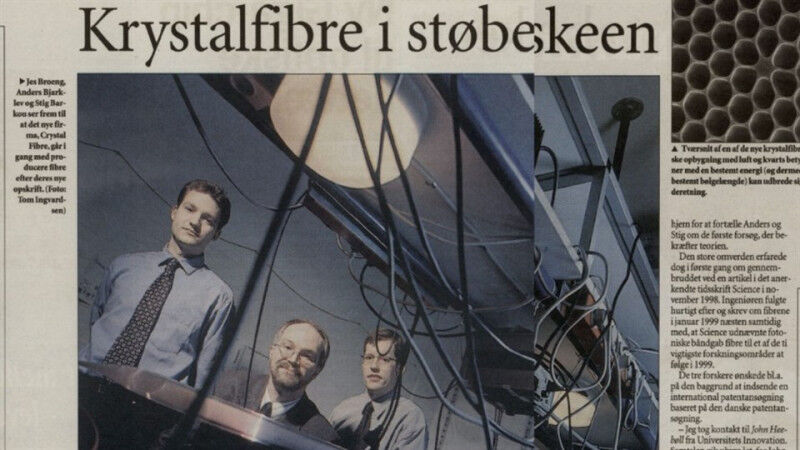
Crystal Fibre is now known as NKT Photonics and employs several hundred people. Co-founder Jes Broeng is a serial entrepreneur and director of DTU’s centre for technology and entrepreneurship, DTU Entrepreneurship, which researches and teaches tomorrow’s tech talents. And Anders Bjarklev’s own supervision of up to 70 students and PhDs has resulted in developing knowledge that is making a real difference, both in Denmark and internationally.
One of them is Jacob L. Philipsen, who is now CEO of the company Advalight and co-founder of the scaleup company Norlase, which makes portable lasers for treating eye diseases. He describes Anders Bjarklev’s guidance as ’crucial’ to his later career choice.
"I was actually the nerdy researcher type, but Anders opened my eyes to the commercial path. If I hadn’t met him, I wouldn’t have ended up commercialising research from DTU," he says.
The fact that Anders Bjarklev himself ended up as President was similarly a consequence of the experiences he had as a company founder. They shaped his mission.
Today, he is proud of the innovation ecosystem created at DTU, which gives students and researchers the optimal framework to innovate and deliver excellent research.
"It is their efforts that make DTU internationally recognised today," says Anders Bjarklev.
"But," he emphasises, "this is not a farewell salute."
In February 2025, DTU’s Board of Directors decided to extend Anders Bjarklev as President for a three-year period. This has led to a whole new goal.
"My next goal is for DTU to hatch 200 new start-ups a year. And that for every 100 of them, 10 must be scalable," he says, elaborating:
"The mission is actually quite straightforward: We need to bring as many good ideas and solutions as possible from the auditoriums and laboratories out into the world where they can make a difference. Or as H.C. Ørsted put it when he founded DTU almost 200 years ago: ’We must utilise natural and technical science - for the benefit of society as a whole.’
Anders Bjarklev’s 40 years of research and innovation
- -1985: Office temp at Copenhagen Telephone Share Company, KTAS- 1985-1988: PhD, Electrical engineering
- 1988-1992: Assistant professor
- 1992-1999: Associate professor
- 1995: Doctor Technices
- 1999: Professor, DTU Fotonik
- 2000: Founded Crystal Fibre A/S, now NKT Photonics, a leading manufacturer of high-quality optical fibres
- 2003-2010: Head of Department, DTU Fotonik
- 2010: Executive Vice President, Provost, DTU
- 2011-2025: President, DTU (extended to 2028)
- 2013: Order of the Dannebrog
- 2015-2022: Chair, Danish Rectors’ Conference, Universities Denmark
- 2020-2023: Chair, Danish Academy of Technical Sciences
- 2023-2024: One of 15 experts in the EU tasked with evaluating and making recommendations on the EU’s efforts within research and innovation.
- Order of the Dannebrog 1st degree - Author of more than 150 scientific papers published in international journals. Author of approximately 20 patent applications, two companies and author of a book on fibre amplifiers (1993) and crystal fibres (2003) Address Anker Engelunds Vej 101 2800 Kongens Lyngby CVR-nr. 30 06 09 46