Quantum chips
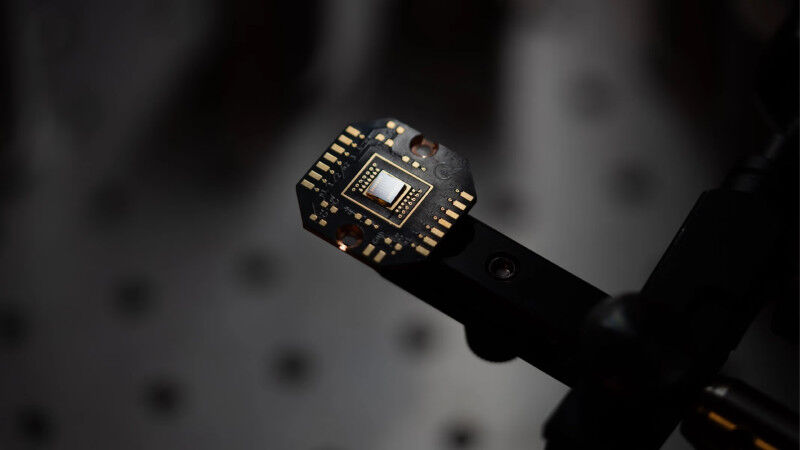
To make quantum chips that can lead to major global advances, you need access to particle-free air and sophisticated equipment. That is why Microsoft and Sparrow Quantum have found their way to DTU Nanolab.
Few companies in the world are at the forefront of the quantum race. Where you go to work to be first, because if you do, you could revolutionize the way our computers do calculations. Forever.
Two companies stand out in the field: Microsoft and Sparrow Quantum. One is a world leader in IT solutions with Danish headquarters in Lyngby near Copenhagen, while the other is a start-up from the Niels Bohr Institute at the University of Copenhagen (UCPH) armed with decades of dedicated quantum research.
Both have developed a quantum chip with huge potential-and both have turned to DTU Nanolab to help them realize it.
"We need ultra-high purity, a production flow with the highly advanced Nanolab machines, and specific standards for how the processes run. Together, this will allow us to produce chips with higher quality and greater reproducibility," says Sparrow Quantum’s CEO Kurt Stokbro.
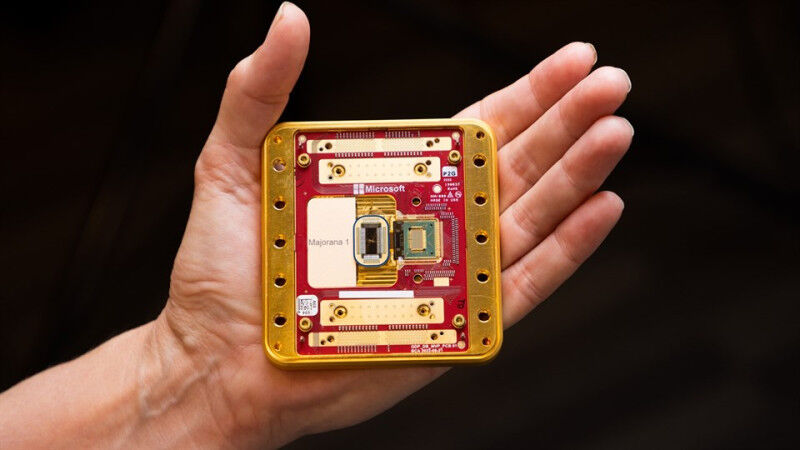
Sparrow Quantum has so far been running an academic set-up at UCPH, where the first generation of the Sparrow Core chip has been created. Now, they are preparing to join DTU Nanolab in 2026.
In parallel, Microsoft has been using DTU Nanolab for several years, while building and developing their own quantum unit, Microsoft Quantum Materials Lab, in Lyngby, in which both UCPH and DTU are partners.
"Access to DTU Nanolab has been a very important part of our development work-not least because the experts involved have been hugely important for us," says Lauri Sainiemi, Vice President, Fabrication, at Microsoft Quantum in Lyngby and responsible for the development of the quantum chip Majorana.
Establishing strong collaborations between industry and academia is a core mission for DTU Nanolab, which takes an open access approach.
It means that relevant industry players can use the infrastructure in DTU Nanolab’s cleanroom to fabricate micro and quantum chips by renting space or becoming partners in a research project.
"This presents valuable opportunity for the vast majority of companies, as it requires huge sums to invest in similar infrastructure," says Jörg Hübner, Director, DTU Nanolab.
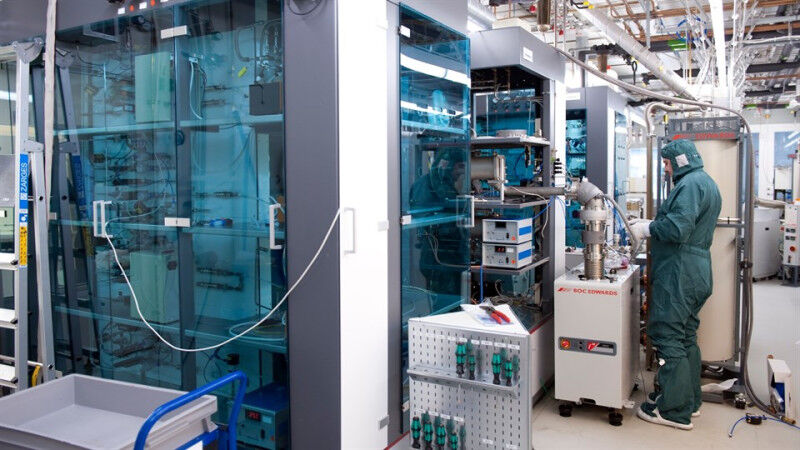
He emphasizes that the lab’s more than 100 specialist employees who conduct research or assist users of the facility with everything from manufacturing processes to characterization methods are a resource that can also be accessed via the open access concept-something which Microsoft has benefitted greatly from.
"DTU Nanolab and all their bright minds have allowed us to test ideas and learn about purchasing our own equipment along the way," says Lauri Sainiemi.
He is currently following optimization of the Majorana 1 quantum chip in Microsoft’s own quantum unit.
"Even now, after investing in our own equipment, we will continue to go to DTU Nanolab. Especially when testing new ideas. Our experts also contribute to the collective knowledge at the University, and in this way I’m happy that we can also give something back to the ecosystem," he says.
ChatGPT moment for quantum computers
For Sparrow Quantum, the next step is to move the production facilities they are building at UCPH to DTU Nanolab.
In May 2025, they accepted the largest investment ever received by a quantum research start-up in Denmark. It totalled EUR 21.5 million, and has enabled the company to purchase the most critical equipment needed for further fabrication.
"We’ve reached a point where our aim is to achieve the highest possible quality with our quantum chips. Some of the tools are so critical that we have to have our own equipment to prevent other materials from causing interference," says Kurt Stokbro.
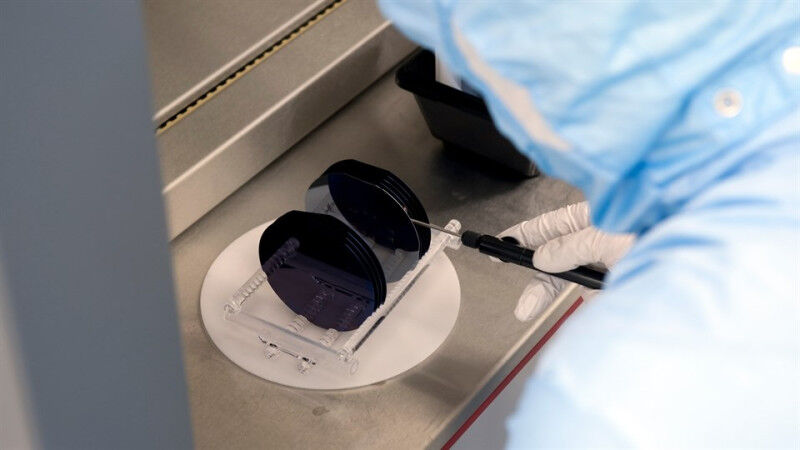
It is therefore also necessary to operate in an environment where the air is as particle-free as possible to prevent particles from settling on the chip and degrading the quality.
For Kurt Stokbro, DTU Nanolab is a "stepping stone" that can potentially help them achieve a technological breakthrough.
"We’re a component supplier to several photonic quantum computing companies, and I think we’ll soon see a quantum computer that does calculations which until now have been impossible. Compared to the turning point that ChatGPT represents within artificial intelligence, you could say we’re moving towards the ChatGPT moment for quantum computing. If our technology can be part of that, it would be fantastic," he says.
Unique ecosystem
Although it is all’about being first in any technological race, there are many ways of getting there according to the two companies. Here, they highlight the quantum environment around Copenhagen as being very special, as a strong collaboration has emerged across universities, start-ups, companies, and investors.
"It’s a unique ecosystem with sharp academic minds, many investors, great ideas for start-ups, and DTU Nanolab providing the infrastructure. One of the main reasons why Microsoft has such a massive presence in Denmark is this ecosystem-it’s a win-win for all’involved, and everyone grows from each other’s accomplishments," says Lauri Sainiemi from Microsoft, which is American-owned with offices worldwide.
For a small country with limited resources, he believes that the ability to create opportunities for each other is precisely the competition parameter that will secure Denmark an international role.
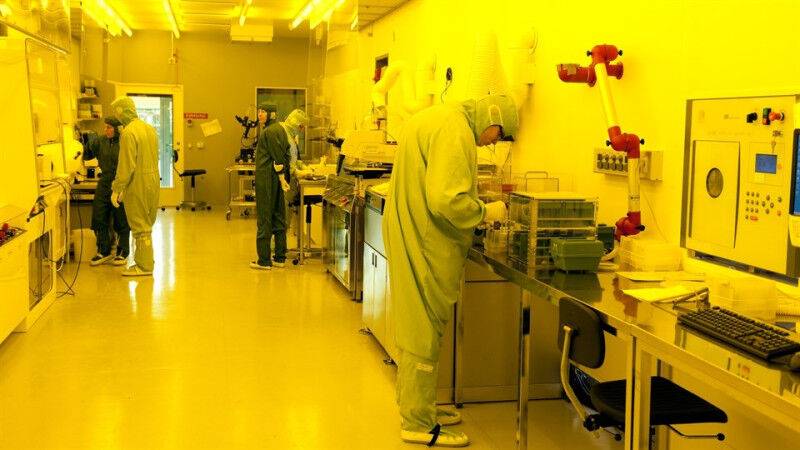
Jörg Hübner, Director of DTU Nanolab, emphasizes that maintaining this position requires that Denmark continues to invest in the latest infrastructure to make it attractive for both small and large companies to stay.
"If we fall behind in terms of equipment and quality, many will have to take the consequences and move production to a country like the USA. We must avoid this at all costs, because it would be a big blow to Europe’s competitiveness," says Jörg Hübner.
So far, however, there are no indications that things are moving in that direction. In 2027, DTU Nanolab is expected to have expanded its facility with a 700-square-metre cleanroom for fabricating tomorrow’s quantum chips.
Address
Anker Engelunds Vej 101 2800 Kongens Lyngby CVR-nr. 30 06 09 46