Interview
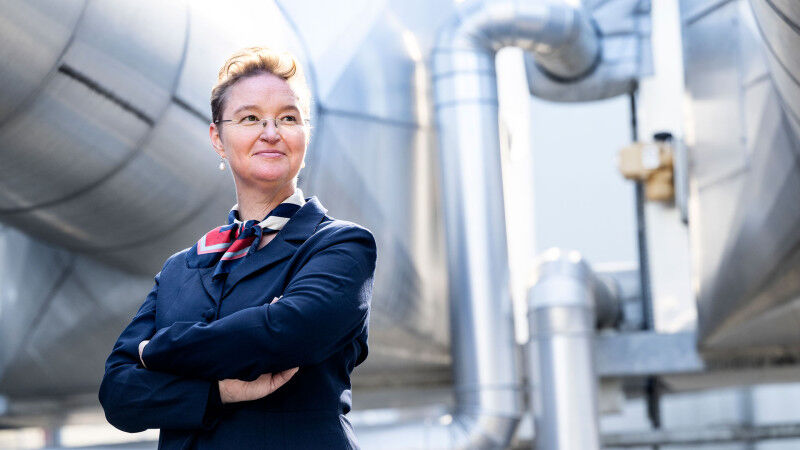
Professor Marie Münster works around the clock on the green transition, both as a researcher and as a member of the Danish Council on Climate Change. In a time of many crises, there is a danger that we will forget about the climate crisis. But if we succeed with the green transition, we may also solve some of the other crises automatically, according to the professor.
The crises are coming thick and fast - trade crisis, security crisis, biodiversity crisis and then the humanitarian crises in conflict and war zones - and they all demand our attention, both politically and economically. Is there a risk that the climate crisis will be drowned out and even deprioritised as a result? Is this discussed in the Danish Council on Climate Change (DCCC)?
When asked, Professor Marie Münster, who has been a member of DCCC since 2023, nods.
"Of course, it’s a concern that society is moving towards spending less on the green transition. It is natural that there are other agendas besides the climate. There always will be, but then we must try to be the ones who maintain focus on the importance of continuing with the green transition," says the professor, who elaborates:
"The green transition is a marathon, and even though there is still some way to go to reach the goal, now is not the time to stop. We must keep running, even if other crises demand our attention."
Marie Münster believes that the green transition is already progressing far too slowly.
"There are days when I think about how much global warming we will experience before we manage to turn the tide. Things are moving far too slowly to turn it around," she says.
The road to security of supply
One leg of the trilemma, security of supply, took centre stage in Europe in 2022 when gas supplies were severely challenged as a result of Russia’s invasion of Ukraine, but security of energy supply will remain important in a fossil-free future when we can no longer meet fluctuating demand for electricity simply by shovelling more or less coal or gas into power plants. The path to security of supply in a fossil-free world must be paved with renewable energy coupled with flexibility, says the professor:
"When our green energy production is challenged by calm or cloudy weather, we need other ways to obtain energy. We can achieve this through flexibility in the energy system. Our analyses show that we can achieve flexibility in four ways: backup, where we use biogas in power plants, for example; transmission, where we buy electricity from our neighbouring countries; storage, where we store heat on a large scale in our district heating network or as electricity in batteries, for example; and finally, shifting energy consumption. The Danes showed that we were quite good at this during the energy crisis in 2022, when high electricity prices led us to do our laundry or charge our electric cars at night," says the professor.
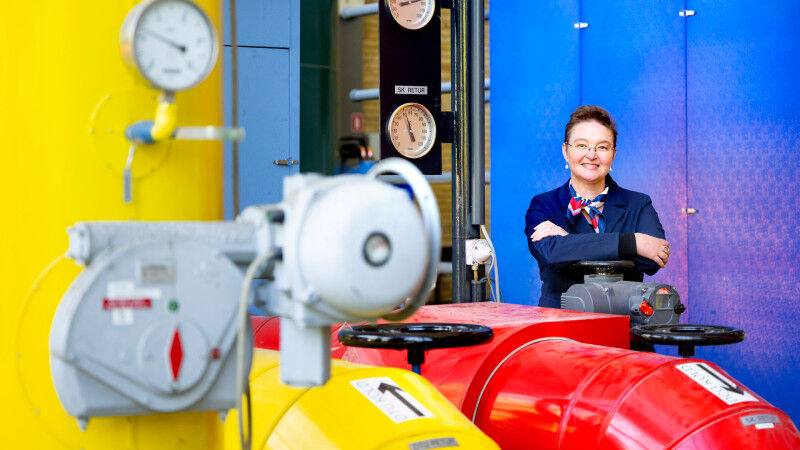
When electricity prices occasionally skyrocket - typically during periods of so-called dunkelflaute (i.e. calm and cloudy weather) - Marie Münster often receives calls from journalists, some of whom try to use the high electricity prices as an argument that the green transition is a dangerous path to take. The professor then tries to calm things down.
"You shouldn’t be alarmed by the short periods when electricity prices fluctuate significantly. It’s the average price we need to look at, and that shows that we have a good price for electricity in this country," says Marie Münster.
Wind, sun and peace
Marie Münster’s thoughts on the green transition extend beyond just a fossil-free energy system. In the professor’s view, the green transition also has the potential to increase a country’s security.
"When nation states produce energy from wind turbines and solar cells, they are also less vulnerable in a war situation, because it is more difficult to attack a country’s energy infrastructure if it is based on decentralised renewable energy, as wind turbines and solar cells are spread across more geographical locations than, for example, coal-fired power plants," says Marie Münster, who also hopes that the green transition can be the path to a more peaceful world.
"Some crises are also about access to energy, and it’s about who controls the resources. If all states have their own green energy supply, they are less dependent on oil and gas-exporting states, for example. During the energy crisis in 2022, when the war in Ukraine started and gas prices rose sharply, Denmark fared better than other European countries because we were not as dependent on Russian gas," says Marie Münster, who also has high hopes for what the green transition can bring:
"With renewable energy, there is an opportunity to decentralise energy production both between states and within countries. This could lead to a better distribution of resources. If we achieve a world with a more equal distribution of resources, I believe we will also achieve more peace. Perhaps this is an idealistic hope, but I believe that the green transition can also be the path to a more peaceful world."
About Marie Münster
- Marie Münster is a professor at DTU Management and a member of the Danish Council on Climate Change.
- She is internationally recognised in the field of energy system modelling and analysis, where she is among the 24 most published researchers in the world.
- In 2025, she was appointed lead author of a chapter on greenhouse gas reduction in the next climate report from the UN Intergovernmental Panel on Climate Change (IPCC).
- In 2021, she received the Agnes and Betzy Award from IDA for her efforts to contribute to solving two of today’s most important challenges: the green transition and gender equality.
- Marie Münster is a frequently used expert in the media, where she contributes her knowledge of the green transition and energy systems.
Address
Anker Engelunds Vej 101 2800 Kongens Lyngby CVR-nr. 30 06 09 46